Entry 01 — First Contact

LANTERN I · Book I
The first trespass was small enough to fit in my palm. I found it on the passenger seat under a streetlamp that turned the windshield into a thin sheet of amber. A metal cutout shaped like an M, or a summation mark if you wanted to pretend this was math and not intent. Hand-filed edge. Clean weight. Cold enough to feel deliberate.
I knew it hadn't been there when I parked. Nothing else was touched. No broken lock. No forced seal. No glovebox disturbed, no papers moved, no opportunistic mess. Whoever placed it had come in and out without leaving the kind of noise ordinary people need.
I held it too long and let one edge bite skin. A shallow line opened across my thumb, neat as punctuation.
At home I set it on my desk beside a dead flash drive and told myself this was a prank from someone with old access and bad timing. I said it twice, because once didn't convince me.
Before the messages, I had been reversing an old Falcon sensor in a retired government-cloud test image. The company maintained legacy infrastructure; old customer builds were the work that survived every announcement about the future. I had brought the image home on one of my personal laptops, telling myself that a familiar problem belonged wherever I could solve it. The laptop was mine. That did not make everything I put on it mine to decide about.
The sensor was only one part of that image. Beside it sat a diagnostic console and a custom return service the old integration had called MIA. I had expected the service to be dead. My work tripped its callback state. The payload was null, but the event still carried a return identifier.
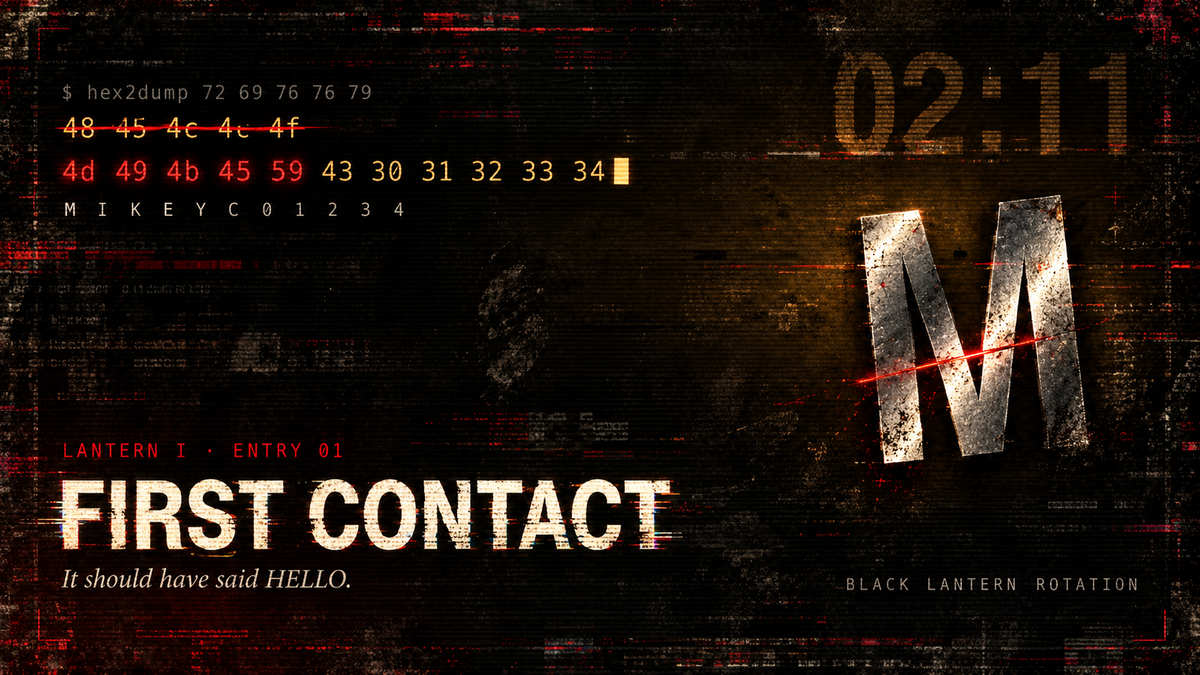
I ran a validity check on my own hex2dump binary before I trusted anything else it told me. Decimal in, hex out, nothing clever about it. I typed the values for HELLO — 72 69 76 76 79 — expecting the tool to hand back 48 45 4c 4c 4f, the plain hex for a word every tutorial starts with. I never bothered typing WORLD. No one was checking my homework.
The dump came back 43 30 31 32 33 34. Not close. Not a rounding error, not a flipped byte order — a different number entirely, for an input that should have had exactly one correct answer. I read it as numbers and got nothing. I read it as ASCII and got C01234. A broken tool would have scared me less. A consistent one meant something else had already been in the pipeline before I ever asked it a question.
I saved the trace and left the console open. There was no useful answer. I mistook that for nobody listening.
Near 02:11, restless, I ran the same HELLO check again, more out of habit than suspicion — decimal in, hex out, the five bytes I already knew by heart. This time the tool gave me eleven.
4d 49 4b 45 59 43 30 31 32 33 34
I read it the way you read a name you don't want to be right about. The first five bytes spelled MIKEY. The six after it I already recognized from an hour before. Not HELLO. My name, and a countdown, sitting in the same clean pipeline that had never once been wrong before this week.
Then nothing.
Mikey belonged to family rooms, not a test image. There were ways to find a childhood name. I could list several without becoming any less frightened. None of them would tell me who was using it now.
I was an infrastructure engineer at an American company, not a man employed to answer strangers at home. I preserved the callback trace before I swept the machine. Restart. Check logs. Check again slower. The eleven-byte reply had used the same return service; the useful payload had changed from nothing to something meant for me.
That gave me a path, not a sender. A sweep with no obvious finding gave me even less. By morning I had an anomaly report ready for the normal queue and a second copy of the raw trace outside the conversational window. I left my own reverse-engineering work in it, including the personal machine. That detail would become expensive.
The next night, same hour, same black window.
count to four before you answer
I should have closed it. I counted instead. One. Two. Three. Four.
who are you
A minute passed. I read intention into it. The terminal supplied only elapsed time.
wrong question
who are you when no one is watching
I sat with my hands in my lap until the numbness reached my wrists. The apartment kept making ordinary sounds — fridge motor, pipe tick, a car passing outside — but each one felt staged, like the world was performing normal in front of me.
I typed nothing.
The line came anyway.
Arch. TTY. native tunnel. no witness.
Four fragments, no punctuation asking permission. I didn't have Arch installed. I had it running inside the hour.
For the next week, reality didn't break. It thinned. My anomaly report acquired a routine classification before anyone asked for the trace. Phrases from private drafts seemed to surface elsewhere; some matched exactly, others only after I had been awake too long. I logged the difference and hated how little the second list could prove.
That was the method: not fear, recognition.
On the eighth night I blacked out the room, opened a clean shell, and sat until my eyes stopped inventing movement in the glass. I placed the metal M beside the keyboard like evidence I would never be able to submit.
Then I typed the only honest line left.
I am here.
The response came at once.
Then listen.
No oath. No threat. No spectacle. Just the feeling of a boundary opened with surgical care.
I called it recruitment later. On the eighth night it was a simpler, less flattering act: I answered an unknown person on a route I had helped wake. I wanted an explanation badly enough to keep the channel open.
The metal M stayed beside the keyboard. Nothing in the callback record told me who had opened the car.