Entry 21 — The second record

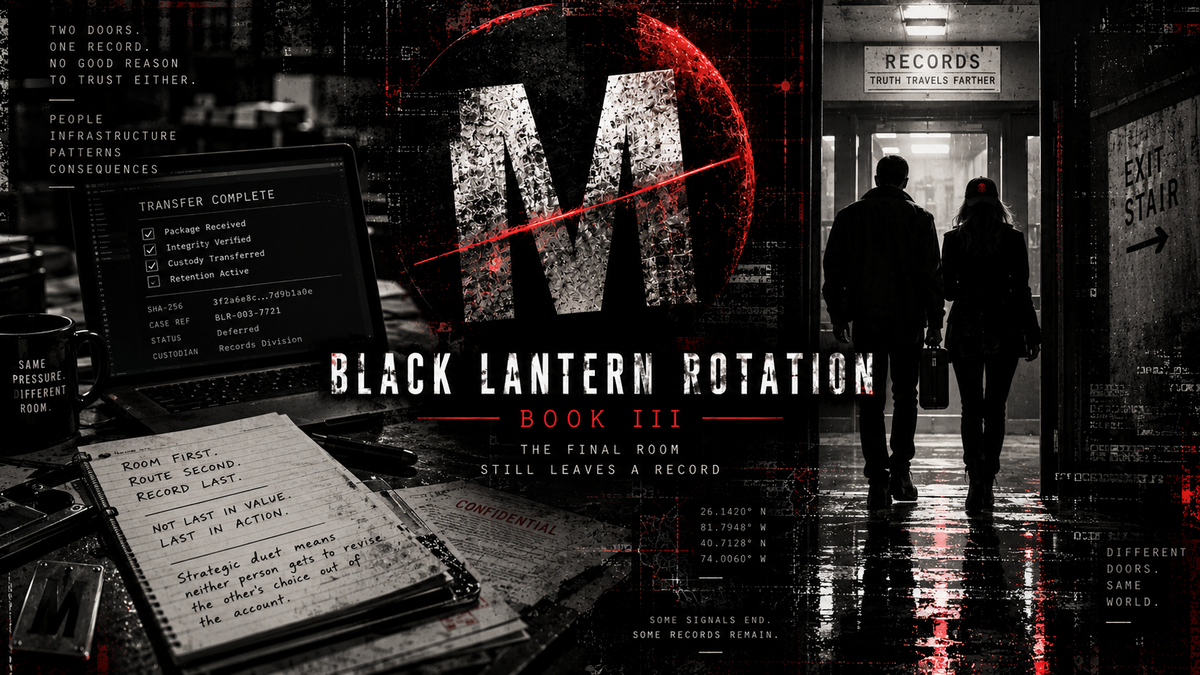
LANTERN XXI
The final room had two doors and no good reason to trust either of them.
We waited in the service corridor behind the review suite. Brooks had told us to use the overflow table while records prepared the transfer. One door led toward the meeting; the other opened onto the public stair. Between them sat a dead printer, an outlet strip taped to the wall, and just enough space for the laptop and the legal pad.
My badge had opened the floor. RedNote's visitor pass had been checked at reception. A camera watched the junction behind us. We were not absent from the building's account of the morning. We were waiting to see whether our account would be permitted into it.
Two channels were open: the review connection on the laptop and RedNote's side channel on my phone. Only one of us would own each action. She would answer in the meeting; I would release the evidence package when the records custodian accepted responsibility for it. A conversation could run beside the work without becoming a second hand on the same decision.
She put the pad beside me and waited until I nodded before writing.
ROOM FIRST.
ROUTE SECOND.
RECORD LAST.
Then underneath:
NOT LAST IN VALUE. LAST IN ACTION.
“You still think I'll chase the pretty version,” I said.
“I think both of us will.”
Through the open service door came the scrape of chairs and a man's voice working through a deck. Brooks was in there, with a records custodian and the people who would decide who inherited my review. Vale attended remotely. I could hear the confidence of the presentation but not enough of the words to use them as evidence.
RedNote looked toward the door.
“He's trying to get beyond the packet before the question arrives.”
I checked the agenda on my screen. The disposition item was next; the preservation acknowledgment was still blank.
“Then we ask before they move it.”
Her hand rested against the edge of the table. For once it was not a correction aimed at me.
Vale sent a private message.
Michael
last chance for a clean history
I left it visible and did not put him on speaker. The meeting did not need to overhear a corridor argument before we had an actual question. The printer behind me clicked once despite having nothing to print.
The package on my screen was not a purified account. My lab trace still showed the event I had triggered on a personal laptop. RedNote's first statement remained beside the correction naming her search for me and her whitelist change. Her employment history was attributed to her, not certified by the index. The incident summary and its revisions were separate files. Brooks's retained notice and Mercer's request supplied another path into the same private authorization. The provisional clock correction stayed attached to our comparison.
Every item had a source note. Some had only a person's account behind them. Others could be compared with independently retained company records. The index said which was which. I had stopped expecting a single word—evidence—to remove the differences.
“You can still leave my statement as an unverified attachment,” she said.
“It is an attributed statement. That is what you gave us.”
“The exception too.”
“The exception too.”
She looked at the door, then back at me.
“All right.”
The words cost more than the certainty she usually brought to rooms. I did not improve them into trust. I watched her choose to remain for the questions.
Inside, a chair moved. Brooks stepped into view and beckoned to her. No invisible authorization, no door persuaded by a good posture. An invited source was being called into a disputed review.
RedNote touched my forearm, briefly, after I offered it. Then she let go and entered.
I heard her first question clearly.
“Before this advances, who cleared the custody language on slide twelve?”
Someone answered that the summary reflected the current security position.
“That isn't the source approval,” she said. “My earlier account is in your packet. So is my correction. Which one are you closing?”
The deck stopped advancing.
On the laptop, the records custodian opened the preservation request. A named recipient, a case reference, a location outside the review team's administration. Not another mirror quietly held by me. I compared the offered destination to the notice Brooks had sent through the formal case. They matched.
My assignment let me request this transfer, not administer what happened after acceptance. That was the point. I would be unable to improve the copy once someone else held it.
The custodian asked for the package manifest. It included a digest for each file. I released it, then the files, and waited while the receiving system calculated the same values from the files it received and checked them against the manifest. The wait was ordinary and unbearable. A progress bar could not tell me what the contents deserved.
Vale sent another line.
You are giving them your own mistake.
I looked at the trace in the file list.
Yes.
Inside the meeting, Brooks asked that the source approval and the facilities request be displayed together. Another voice asked why the closure language omitted the outstanding infrastructure dispute. RedNote did not have to supply every question. That was the first sign the room had begun doing work we could not do for it.
The receiving acknowledgment appeared. It named the package version, recorded the integrity check for the transfer, and placed it under the records team's retention control. It established that the received files matched the submitted manifest, not whether every assertion inside them was true.
I saved the receipt.
Then I heard Brooks say, “Hold the disposition. We need the source material before a new owner signs this.”
The agenda changed on my screen. Closure deferred. Source review requested. The recommendation to return the disputed integration to routine handling was suspended pending that review. My pending reassignment remained.
It was not exposure of an entire military operation. It was not an acquittal, an arrest, or a guarantee that the company would act well tomorrow. One meeting had stopped treating Vale's summary as a sufficient ending. One copy had a custodian neither of us could revise through the old lane.
Vale's private window lit again.
what did you do
I could have given him witness. I could have made it sound like a final line.
The retained package is acknowledged. Your closure request is still disputed.
There was no reply.
I kept the window open until its session ended. Silence could mean he was thinking, speaking elsewhere, or no longer interested in using me as the cheapest route. I did not assign it a defeat I could not see.
RedNote came back to the corridor with a request to remain available for a separate interview. No one had offered her a clean name in exchange for a useful packet. She had agreed to answer for the statement she had corrected in the kitchen.
“Held?” she asked.
I turned the screen toward her.
She read the receipt and the deferred disposition. Then she read the reassignment notice beneath them.
“Your access.”
“Changes after the meeting.”
“You knew it might.”
“Yes.”
For months I had treated continuity as the punishment of not getting to carry the signal to the end. Now I could see my own access expiring and another person's receipt beside it. The record did not need me to remain its only door.
She returned the legal pad to me. Beneath the lines she had written, I added:
Strategic duet means neither person gets to revise the other's choice out of the account.
She read it.
“Keep the earlier definitions too.”
I left a reference to the pages where I had meant something else.
We did not kiss. There was still room for wanting. She had a further interview. I had a manager waiting for an explanation I could no longer confine to the wire.
I unplugged the laptop from the outlet and closed it. We left through different doors.
At the stairwell I almost said zàijiàn. Even in my own mouth I could still hear the senior voice. I let it go unsaid. She took the hall toward the interview room with her pass where reception could see it. I took the stairs.
Outside, the rain had stopped. My account lost its infrastructure-owner access before I reached the car. The preservation receipt remained available in the case correspondence. Those were the two changes I could verify that morning.
At the apartment I set the pad beside the dark terminal. The metal M stayed in the drawer. I had no new explanation for it and no need to force one out of the sensor trace.
The line that had found us was gone. A record neither of us owned was still there.
I left space beneath the last entry.